When Is it Time to Stop Renting SaaS and Build Your Own Custom App?
There is a distinct financial tipping point in every local business where "affordable" monthly software subscriptions metastasize into a massive, unrecoverable tax on your profit margins. Renting off-the-shelf software is logical for a startup, but fundamentally destructive for an established enterprise.
The SaaS Rental Squeeze
Businesses inherently waste a staggering 51% of their purchased SaaS licenses on inactive users, creating a silent hemorrhage in monthly cash flow. When you pay on a strict per-user pricing model, your software expenses scale aggressively alongside your headcount, actively penalizing you for growing your team.
Most companies subscribe to generic software under the illusion of predictable operating costs. However, as your operations expand beyond 15 employees, this model breaks down. You are no longer paying for the utility of the software; you are permanently subsidizing the revenue targets of external tech corporations without building any equity in your own digital infrastructure.
To break out of the rental squeeze:
- Audit Seat Utilization: Immediately identify how many $200/month dispatch or CRM licenses are assigned to field workers who barely log in.
- Cap Operating Expenses: Stop allowing your core cost of goods sold (COGS) to be dictated by third-party vendor pricing updates.
- Pivot to Ownership: Recognize that custom engineering limits software costs to fixed capital expenditures (CAPEX) rather than infinitely scaling operating expenses (OPEX).
Shadow IT and the Fragmented Data Nightmare
Nearly one-third of all applications operating within a standard business today are purchased via decentralized "Shadow IT," creating massive data fragmentation and critical security vulnerabilities across your client accounts.
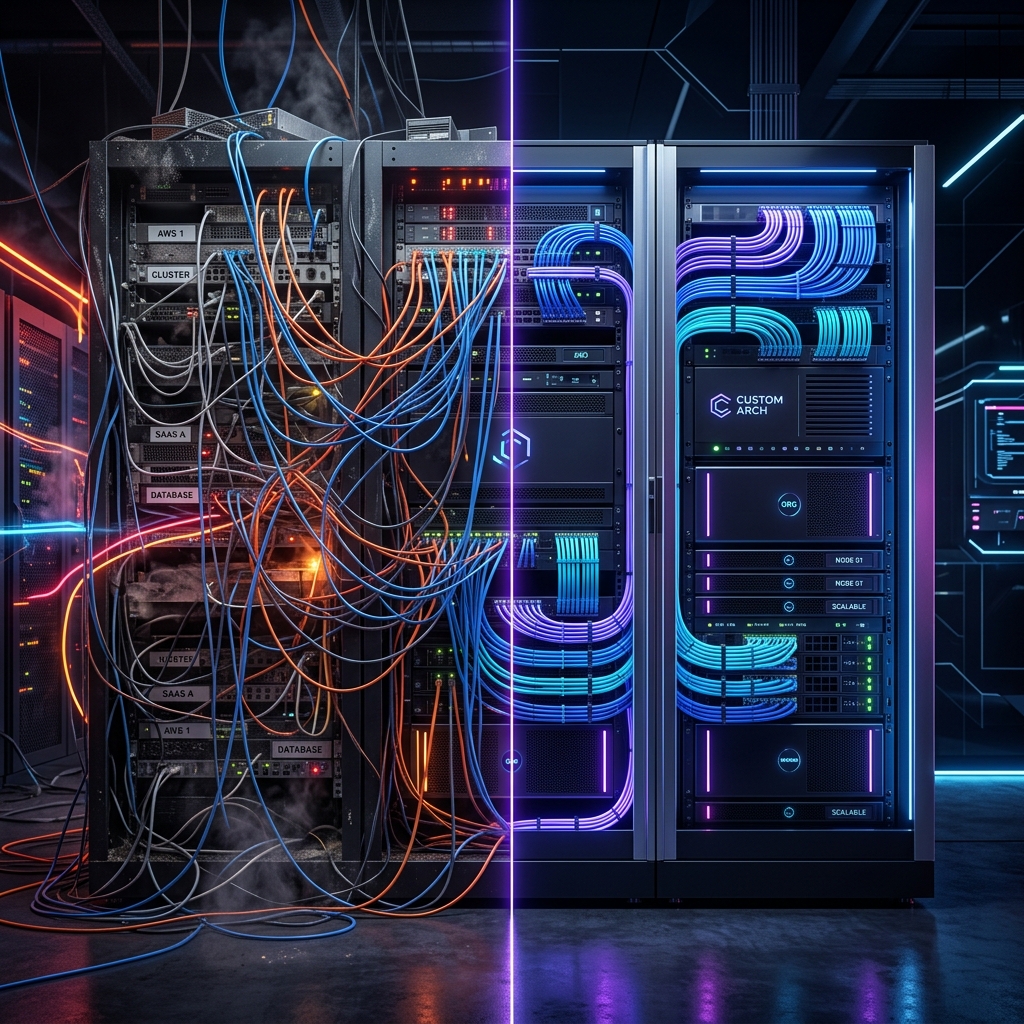
When a company relies on six different SaaS platforms to run sales, service, accounting, and communication, the business does not truly own its data—it leases it across a vulnerable, fragmented ecosystem. If your business requires manual data entry to move information from your marketing CRM to your field technician's mobile dispatch app, you are losing 20% of your labor efficiency to redundant administrative work.
- Data Sovereignty: Operating on disparate platforms means customer information is constantly exposed across multiple external servers.
- API Breakage: Connecting six different cloud tools with generic connectors (like Zapier) creates an incredibly fragile operational backbone.
- The Unified Solution: A single custom enterprise application centralizes all data natively, completely eliminating manual transfer errors and drastically tightening security protocols.
Calculating Your Custom Software Break-Even Point
Transitioning to custom software shifts your financial profile from a perpetual loss column into an owned digital asset that mathematically hits its break-even point much faster than executives assume.
Building custom software requires an upfront capital investment, but the math shifts violently in favor of ownership as a company crosses the 15-employee threshold. Once the initial build is complete, adding your 16th, 50th, or 100th employee to your proprietary system costs you absolutely nothing in licensing fees.
Total Cost of Ownership (TCO): 3-Year Projection Matrix
The following table illustrates the financial impact of renting heavily-fragmented SaaS versus owning a unified custom application over a 36-month timeline.
| Cost Metric | Generic SaaS | Custom App |
|---|---|---|
| Implementation | Low | High (CAPEX) |
| Monthly Fees | $3,000+ | $0 |
| 3-Year Spend | $108,000+ | Stabilized |
| Equity | 0% | 100% Owned |
Stop Re-Renting Your Infrastructure
You would never lease a fleet of service trucks for thirty years without building any equity; you should not treat your operational software any differently.
To permanently stabilize your profit margins and secure your data, it is time to transition from a renter to an owner. Discover how true digital strategy transforms your disjointed operations into a streamlined, highly profitable enterprise machine.